
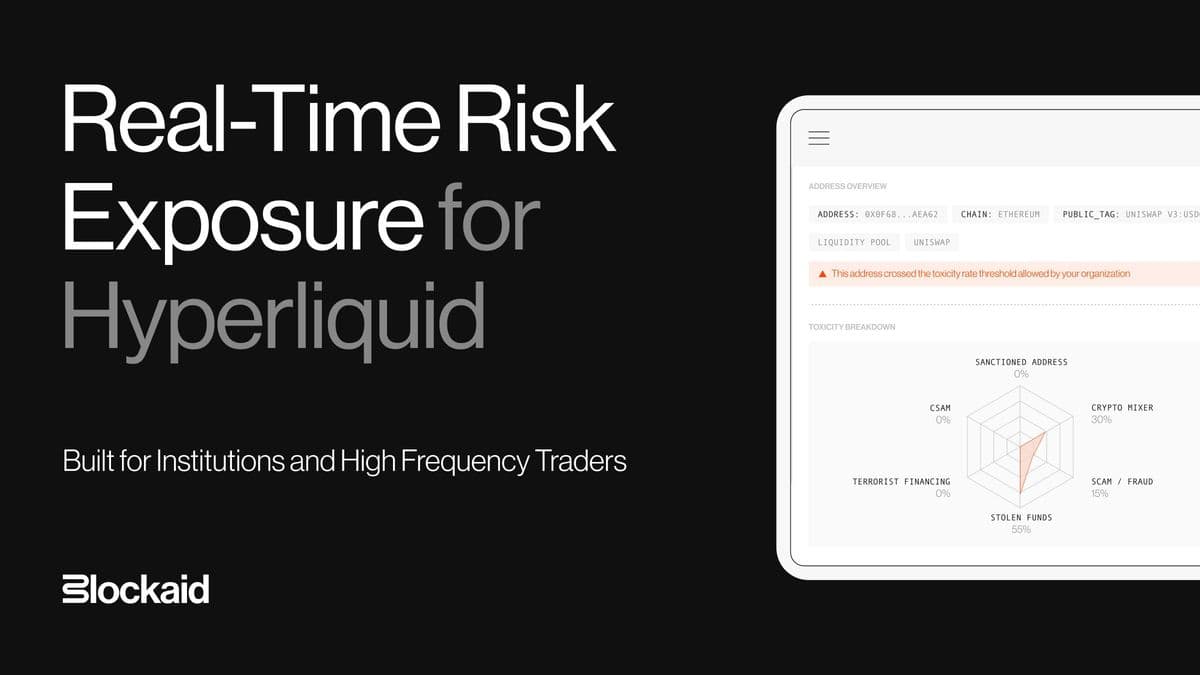
Real-Time Risk Exposure for Hyperliquid: Built for Institutions and High Frequency Traders
Hyperliquid has become the dominant venue for perpetuals, accounting for nearly 50% of all onchain perps volume onchain and over 60% of total open interest in DeFi. Total trading volume has grown to rival many centralized exchanges where perps trading has historically taken place.
Institutions have been drawn to Hyperliquid for its performant, customizable infrastructure, deep liquidity, and low-latency execution. That value proposition has held as Hyperliquid expanded from HyperCore into HyperEVM, adding lending, staking, and vaults, and HIP-3 extends it further, from crypto assets into tokenized RWAs like commodities, equities, and FX. For institutions and HFTs, the biggest unlock is continuous cross-venue arbitrage, particularly for traditional asset classes.
Despite the clear interest and demand, institutional access still runs into regulatory challenges. As currently an unregistered derivatives Exchange, Hyperliquid today is not formally regulated, and global regulators have taken contrasting stances on the significant activity in this ecosystem. What isn't ambiguous is that the regulated institutions that participate in Hyperliquid remain subject to their own AML, KYC, and sanctions obligations, including screening for funds tied to sanctioned wallets or known illicit actors. Doing that on a permissionless chain such as Hyperliquid, in real time, is a problem firms never face on a centralized venue, where they rely on the exchange's compliance desk sitting between every trade.
Blockaid is the proactive solution for these regulated trading firms. Blockaid provides real-time onchain monitoring, risk exposure scoring, and pre-transaction security across both of Hyperliquid's runtimes (HyperCore and HyperEVM) through a single platform. We've indexed both since 2025, ahead of the rest of the market, which is why institutional desks and HFT firms trading Hyperliquid at scale increasingly run their compliance and security through Blockaid.
Why real-time compliance matters now: HIP-3 and HIP-4
Hyperliquid's expansion from a standalone perpetuals exchange into deployable market infrastructure is multiplying how many markets need underwriting, and fast:
- HIP-3 (live since October 2025) opened permissionless perpetual futures listings to outside builders. Trade.xyz, for example, deployed markets for non-crypto assets like tokenized stocks, commodities, and indices.
- HIP-4 (live since May 2026) introduced outcome contracts for prediction and event markets on the same HyperCore stack. The most popular listings so far span crypto (BTC up/down, price ranges), sports (World Cup outcomes), and economic events (CPI, Fed decisions).
Both have accelerated institutional interest: market makers and HFTs get 24/7 access to stocks and commodities, plus broader hedging and cross-venue arbitrage on top of it. As of July 2026, total volume from HIP-3 markets surpassed trading volumes on all other Hyperliquid markets, accounting for more than 50% of total Hyperliquid volumes.
But as more builders launch markets more easily, counterparty screening gets harder. A permissionless perp or prediction market has no track record when it launches, including limited history on who’s providing liquidity, who's taking the other side of trades, or where their funds came from. Each new deployer, market, and event listing on Hyperliquid is its own unique contract that must be screened for illicit funds, and the number of pools requiring coverage grows faster than any manual or batch process can keep up with.
Most compliance screening providers aren't built for this pace. Scanning every address daily, then rescanning post-trade, doesn't scale to a market moving this fast, and it's already too late if a tainted pool was touched before the scan caught it. Some providers reportedly take up to three days to respond to customer requests to add new addresses belonging to newly deployed markets. Many also stop at HyperEVM: their coverage is built for EVM chains, and HyperCore's execution environment falls outside it.
Risk Exposure: proactive compliance at the speed institutions demand
Blockaid Risk Exposure is built to close those gaps: real-time verdicts, pre-execution enforcement, and detection fast enough to matter for institutions and HFTs trading HIP-3 and HIP-4 markets on Hyperliquid.
How Risk Exposure Works
Blockaid's API screens transaction flows in real time, at over 100 reads per second, scoring markets and pools, not just addresses, across 25+ configurable categories, including sanctions, stolen funds, scams, and mixers. Every check returns a top-level signal (Benign, Warning, or Malicious) backed by a full exposure breakdown. Policy-ready outputs plug directly into Cosigner: if a transaction breaches a configured AML exposure limit, Cosigner rejects it before it clears.
Risk Exposure also runs continuous surveillance across DeFi environments, sampling exposure on an ongoing basis and alerting the moment a threshold is breached, whether or not an institution is actively transacting. It assesses exposure across every address gaining funds in a transaction, not just the counterparty, and the underlying data model updates continuously as Blockaid detects new exploits, front-end attacks, and DNS takeovers.
Why a Proactive Compliance Stance is Needed
Blockaid recently submitted comments to the CFTC on its proposed public interest framework for prediction markets, arguing that periodic, sample-based review isn't built for markets that settle onchain in seconds. In a six-month engagement with one prediction market operator, Blockaid's real-time detection identified more than 86,000 wallets engaged in suspected wash trading, and that operator reported roughly a 55% drop in wash trading attempts after deploying it, evidence that continuous monitoring can deter manipulation rather than just document it afterward. The same logic applies directly to HIP-4's outcome markets on Hyperliquid, where activity around a high-attention event is exactly where coordinated wash trading is hardest to catch with a static address list and easiest to catch with continuous behavioral monitoring. The CFTC's own proposal treats a market's compliance capacity, meaning whether its surveillance is periodic or continuous, as a factor in whether it serves the public interest. That's the same question institutions trading Hyperliquid's newest markets need to answer for themselves.
A proactive compliance stance pays off operationally and with regulators. A forensic tool answers what happened to a set of funds after the fact; Risk Exposure answers whether to interact with an address, pool, or market right now, before a transaction clears. To get ahead of what regulators are starting to expect, prevention has to be the primary posture, with forensics as the backstop. "We screened this in real time and can show our thresholds" is a materially stronger position than "we can trace what happened once it did."
Learn more about Blockaid's Risk Exposure →
Proven with institutional trading desks
- A digital asset manager affiliated with one of the largest investment banks in Asia (~$400B+ AUM) uses onchain monitoring, cosigner protection, and risk exposure toxicity scoring to screen counterparty risk before trades clear.
- An institutional cross-border payments and settlement provider clearing over $3T annually uses real-time monitoring to catch anomalies across its transaction flows.
- An institutional OTC liquidity provider processing 60M+ transactions daily combines reactive detection with predictive toxicity modeling, and switched to Blockaid largely because it was the only vendor that could support Hyperliquid the way they trade it.
Strengthening Security for the Hyperliquid Ecosystem
That relationship extends to Hyperliquid itself. Hyperliquid integrates Blockaid's wallet security scanning directly into its own front end, screening the transactions and contracts a user is about to sign before they sign them. That's the same simulate-and-validate protection Blockaid runs for other major wallets and exchanges, applied to traders connecting a wallet to Hyperliquid's interface, and it catches malicious contracts and scam attempts before they ever reach a signature. It's a different layer from the Risk Exposure and compliance tooling institutions run on top of Hyperliquid: one secures the interface every trader connects to, the other gives trading desks the counterparty and market visibility they need to meet their own compliance obligations.
Get started
Institutional interest in Hyperliquid keeps accelerating, and HIP-3 and HIP-4 are giving market makers and HFTs new markets to trade at a pace few teams can track manually. Keeping up requires real-time compliance, not periodic review. Blockaid's Risk Exposure gives institutions a proactive compliance posture built for exactly that: real-time screening across both HyperCore and HyperEVM. Reach out to discuss how Blockaid can meet your firm's compliance needs.
About Blockaid
Blockaid is the onchain security platform trusted by the largest companies operating in Web3. Built by veterans of elite intelligence and cybersecurity units, Blockaid provides end-to-end protection for financial institutions, protocols, and end users, combining direct wallet and dApp integrations with real-time monitoring, detection, and response across smart contracts, infrastructure, and externally owned accounts. Since 2025, Blockaid scanned over 6.3 billion transactions and blocked 585 million attacks. Blockaid is the security infrastructure behind Coinbase, MetaMask, Uniswap, Safe, and dozens of the most widely used platforms in the industry.
Learn more at Blockaid.io, and follow us on Twitter and LinkedIn.
Blockaid is securing the biggest companies operating onchain
Get in touch to learn how Blockaid helps teams secure their infrastructure, operations, and users.
Related Posts
A Billion-Dollar Blind Spot: What Compliance Teams Miss in DeFi Transaction Monitoring
Blockaid Brings Onchain Monitoring and Cosigner to Concrete's Vault Infrastructure