

Introducing Recommended Policies for Cosigner: Onchain Operational Security, Powered by AI
Executive Summary
A large transfer to a new address is routine treasury operations at one company and a fireable mistake at another. This is security's oldest problem, because understanding and preventing risk requires two things that rarely coexist, a security expert, and someone who understands the context of how the organization actually operates. Blockaid has solved the expert half at scale, leading the industry at turning unknown threats into known ones, and that knowledge is universal, since identifying one malicious address protects every customer automatically. What no threat feed can answer is the question a CISO actually asks, what normal looks like for this organization, and whether the right guardrails are in place for how it operates.
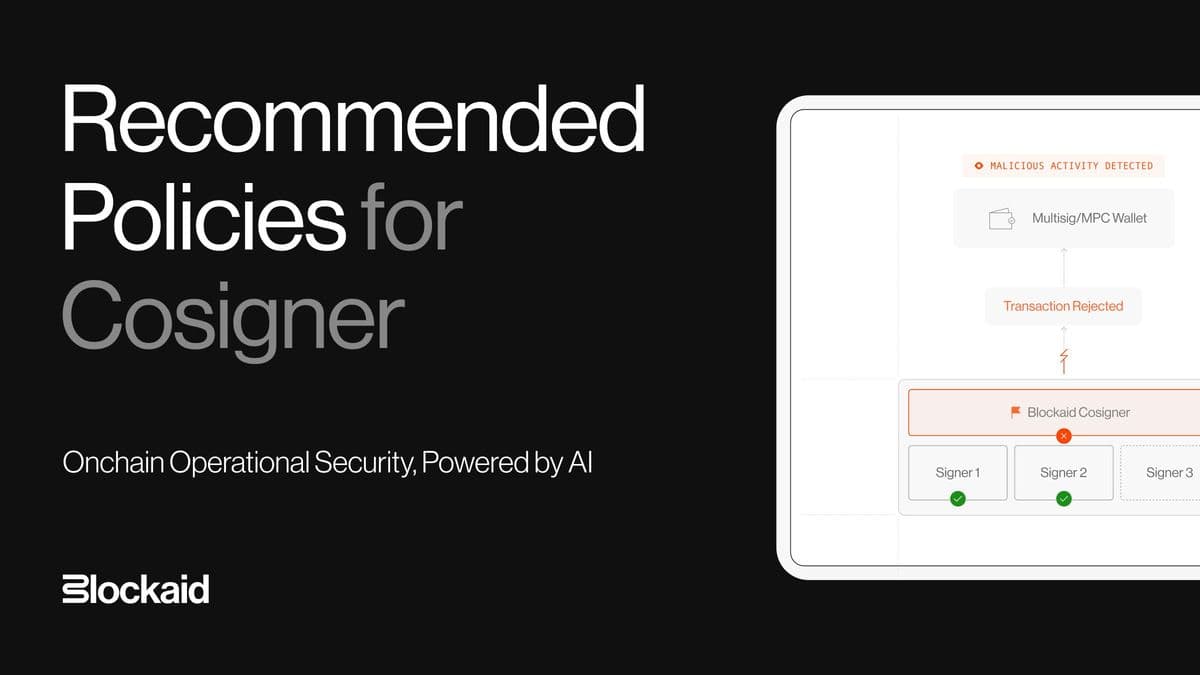
Blockaid is closing that gap with Recommended Policies, a new Cosigner capability now live in Beta. Point Cosigner at a wallet and it reads the wallet's recent onchain activity, then proposes a policy set built from what the wallet actually does, the counterparties it pays, the contracts it calls, and the transfer patterns that repeat, checked against everything Blockaid knows about how wallets get attacked.
Every draft policy arrives with the rationale behind it, a real transaction from the wallet's own history that it would have matched, and a count of how much historical activity it covers. Teams review each proposal, refine and reorder the set, test it against real transactions before saving, and keep the final judgment call in their own hands, since nothing takes effect until it is approved.
This post covers how Recommended Policies works, how Blockaid makes AI reliable enough for high-stakes security, where the feature fits within Blockaid's Cosigner product, and why teams pair Cosigner with Onchain Monitoring.
Introducing Recommended Policies for Blockaid’s Cosigner
Cosigner's policy engine gives teams granular, composable control over how a cosigner approves or rejects transactions, and assembling the right rule set around a specific operation has always been the part that takes effort, because it requires security judgment and a working knowledge of everything the wallet does. Recommended Policies does that assembly. It reads the wallet's real onchain footprint and builds the policy set around the wallet's actual activity profile, so the rules fit the operation they are meant to govern.
Recommended Policies is live in Beta inside Cosigner. The proposals are grounded in the wallet's own history and checked against everything Blockaid knows about how wallets get attacked, and they arrive as drafts to review rather than rules that enforce themselves.
How It Works
Analyze and generate. From the Cosigner Policies page, click Generate with AI, then Next. Generation takes a few seconds, it can be canceled at any time, and the existing policy set stays untouched until you choose to save.
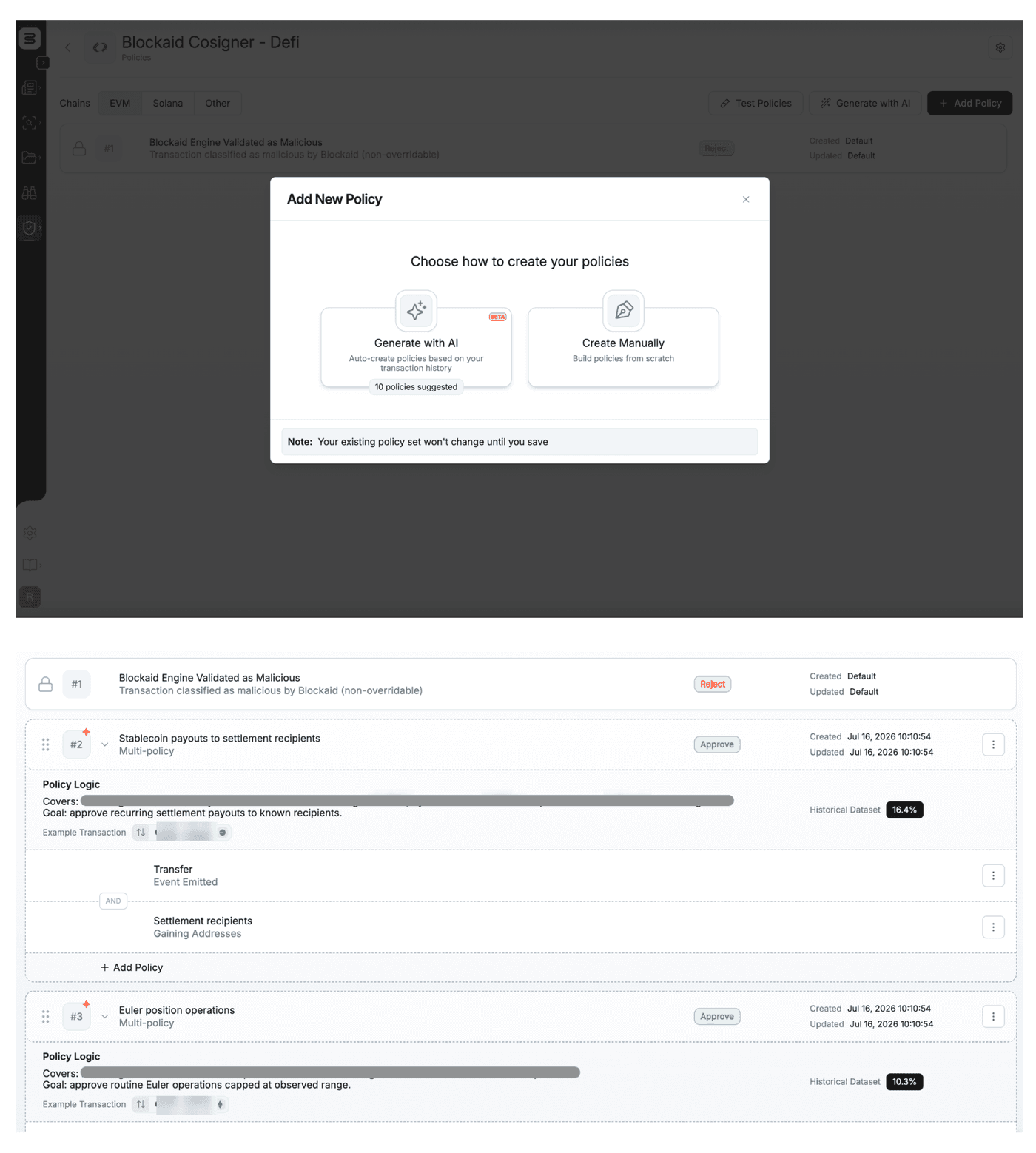
Review. Every draft policy comes with three things to evaluate:
- Policy Logic - the rationale for the rule, what behavior it enforces and why, so you can check it against your intent.
- Example Transaction - a real transaction from your own history that this policy would have matched, so you can confirm it catches the right activity.
- Historical Dataset - how many of your past-90-day transactions matched, 14 of 20 transactions for example, so you can gauge coverage and how often the rule will fire.

Refine and save. Edit any field via the ellipsis menu, drag to reorder, or delete the proposals you do not want. Click Save Changes and the drafts become active. Policy order is yours to control, and the built-in malicious-detection rule stays pinned at the top.
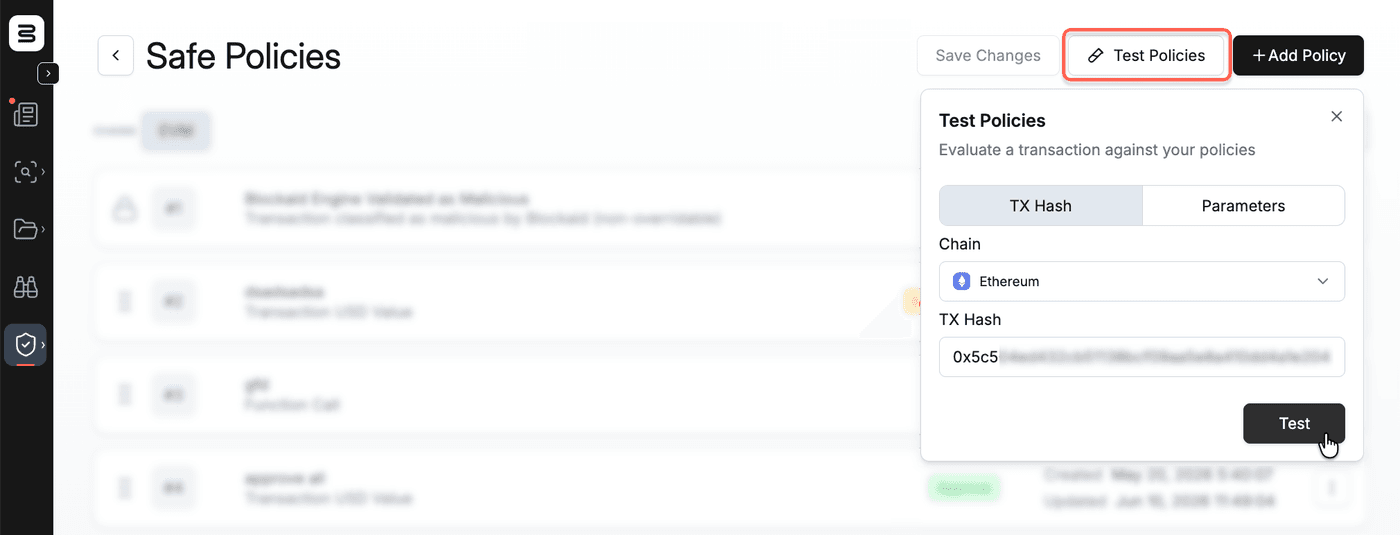
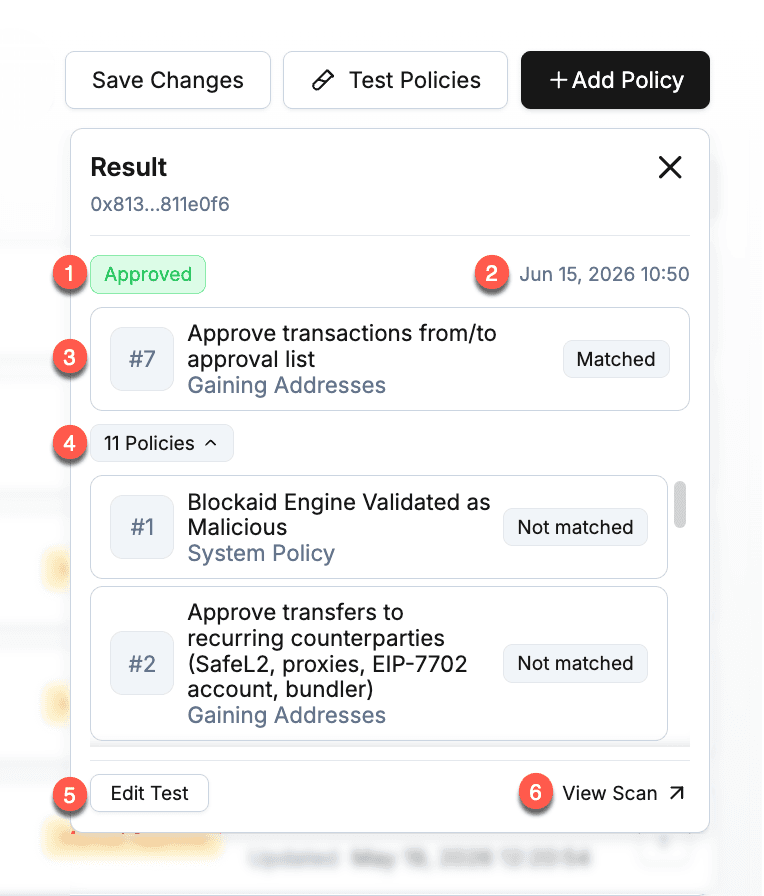
Test before you commit. A recommended set is a strong starting point, and Test Policies is how you confirm it will protect you before you rely on it. Run any real transaction hash, or simulated parameters, against your current policy set, including unsaved edits, and you see the decision, which policy matched, and a full per-policy evaluation trace, all without sending anything onchain. Recommended Policies is available on EVM cosigners, and Test Policies works on both EVM and Solana, so you can validate a policy set against real activity on either chain.
Making AI Reliable Enough for High-Stakes Security
A policy governing signing on a treasury has to be verifiable, since plausible is nowhere near the bar. So the model's role is deliberately narrow. It reads a structured record of the wallet's activity, produced by the same data layer that screens transactions across the wallets, chains, and apps Blockaid protects, in which counterparties carry attribution labels from years of threat research and contracts carry classifications from Blockaid's exploit-detection work, and it proposes candidate rules. Everything that makes those proposals trustworthy happens outside the model, deterministically:
- Every draft is verified against the history it came from. Each proposed rule is replayed against the same 90 days of transactions it was built on, and its coverage is computed rather than estimated, which is where the match count on every proposal comes from. Drafts that fall short go back through with that gap as feedback before a person ever sees them.
- Researchers' judgment is enforced in code rather than prompts. Ownership and admin-permission changes route to manual review no matter what the model drafts, and a proposal that does not tie back to a real transaction pattern is dropped rather than surfaced.
- A human approves everything. Nothing enforces until you save, the built-in malicious-detection Reject policy stays pinned and cannot be overridden, and Test Policies lets you run real transactions against the drafts before committing to them.
The model does the drafting, and Blockaid's data and encoded expertise do the deciding. Critically, the policies it drafts can only make a cosigner more restrictive, never more permissive. Adopting a recommended set narrows a wallet's attack surface rather than widening it, and the baseline protection is unchanged either way.
How Blockaid's Cosigner Keeps Every Transaction Within Policy
Cosigner is the layer for risk inside the transaction, an independent approver in the signing path that blocks a compromised device, an unintended admin action, or a mis-routed payment before it is signed:
- Native signer integration - Cosigner joins multisig and MPC workflows, including Safe, Fireblocks, and Squads, as an additional signer, with no new tools, no new transaction formats, and no custom infrastructure required.
- Simulation-based validation - Cosigner receives the raw transaction payload and simulates its full onchain execution before any signature is applied, evaluating what the transaction will actually do rather than what a frontend displays.
- Granular policy enforcement - Custom, label-based policies enforce each organization's rules on every transaction, from counterparty controls to transfer thresholds to admin-action reviews, evaluated in order until one matches.
- Real-time threat detection - Every cosigner ships with a built-in, non-overridable Reject policy, pinned to the top of the policy list, that blocks anything Blockaid's detection engine flags as malicious.
Blockaid's Onchain Monitoring covers the risk around the transaction, keeping continuous watch over the oracles, collateral, and contracts your positions depend on and catching threats that build gradually or surface elsewhere. Between them, nothing onchain is left uncovered. Both layers are only as good as how well their policies fit your environment, and Suggested Policies makes that fit automatic.
Learn more about Blockaid's Cosigner →
Conclusion
"Security tailored to your environment" used to come with a catch. The tailoring was manual, so it was slow, and it went stale the moment your behavior changed. A new Cosigner now gets a policy set fitted to that wallet's real operating pattern as a starting point to review rather than a project to staff, and it refreshes monthly as your activity evolves. The judgment call is still yours. You just do not need to get an expert and an insider into the same room first.
Suggested Policies is in Beta now inside Cosigner, for EVM cosigners with at least 10 transactions in the last 90 days. If you are standing up a new wallet, or running one on a policy set nobody has revisited in months, your history already suggests what your policies should be. Generate a draft and see.
About Blockaid
Blockaid is the onchain security platform trusted by the largest companies operating in Web3. Built by veterans of elite intelligence and cybersecurity units, Blockaid provides end-to-end protection for financial institutions, protocols, and end users, combining direct wallet and dApp integrations with real-time monitoring, detection, and response across smart contracts, infrastructure, and externally owned accounts. Since 2025, Blockaid scanned over 6.3 billion transactions and blocked 585 million attacks. Blockaid is the security infrastructure behind Coinbase, MetaMask, Uniswap, Safe, and dozens of the most widely used platforms in the industry.
Learn more at Blockaid.io, and follow us on Twitter and LinkedIn.
Blockaid is securing the biggest companies operating onchain
Get in touch to learn how Blockaid helps teams secure their infrastructure, operations, and users.
Related Posts
Blockaid Brings Onchain Monitoring and Cosigner to Concrete's Vault Infrastructure
Blockaid Partners with LayerZero to Bring Security Verification to Cross-Chain Bridging Transactions
.webp&w=1920&q=75)