
Blockaid Partners with LayerZero to Bring Security Verification to Cross-Chain Bridging Transactions
The Partnership: Inline Security for Cross-Chain Messaging
LayerZero is an omnichain interoperability protocol that lets applications move tokens, data, and messages across blockchains as if they ran on a single network. Each application selects the Decentralized Verifier Networks, or DVNs, that must attest to its messages before they execute, and that application-configured verification layer has carried more than $300 billion in transferred value across the protocol's supported chains.
To enhance security at the attestation layer, Blockaid has partnered with LayerZero to launch Blockaid Bridge Sentinel, a security-focused DVN built for token issuers moving assets across the protocol. A standard DVN confirms that a message is authentic. Blockaid Bridge Sentinel offers an additional level of security focused outside of the token action, screening each transfer against Blockaid's real-time detection engine before adding its attestation.
For issuers that set Blockaid Bridge Sentinel as part of their DVN configuration, the security check runs inside the attestation itself, so a message with no real source event, a malicious counterparty, or a transfer moving stolen funds is refused before it can become a loss for the people holding the token.
How It Works: Blockaid Bridge Sentinel Inside the DVN Stack
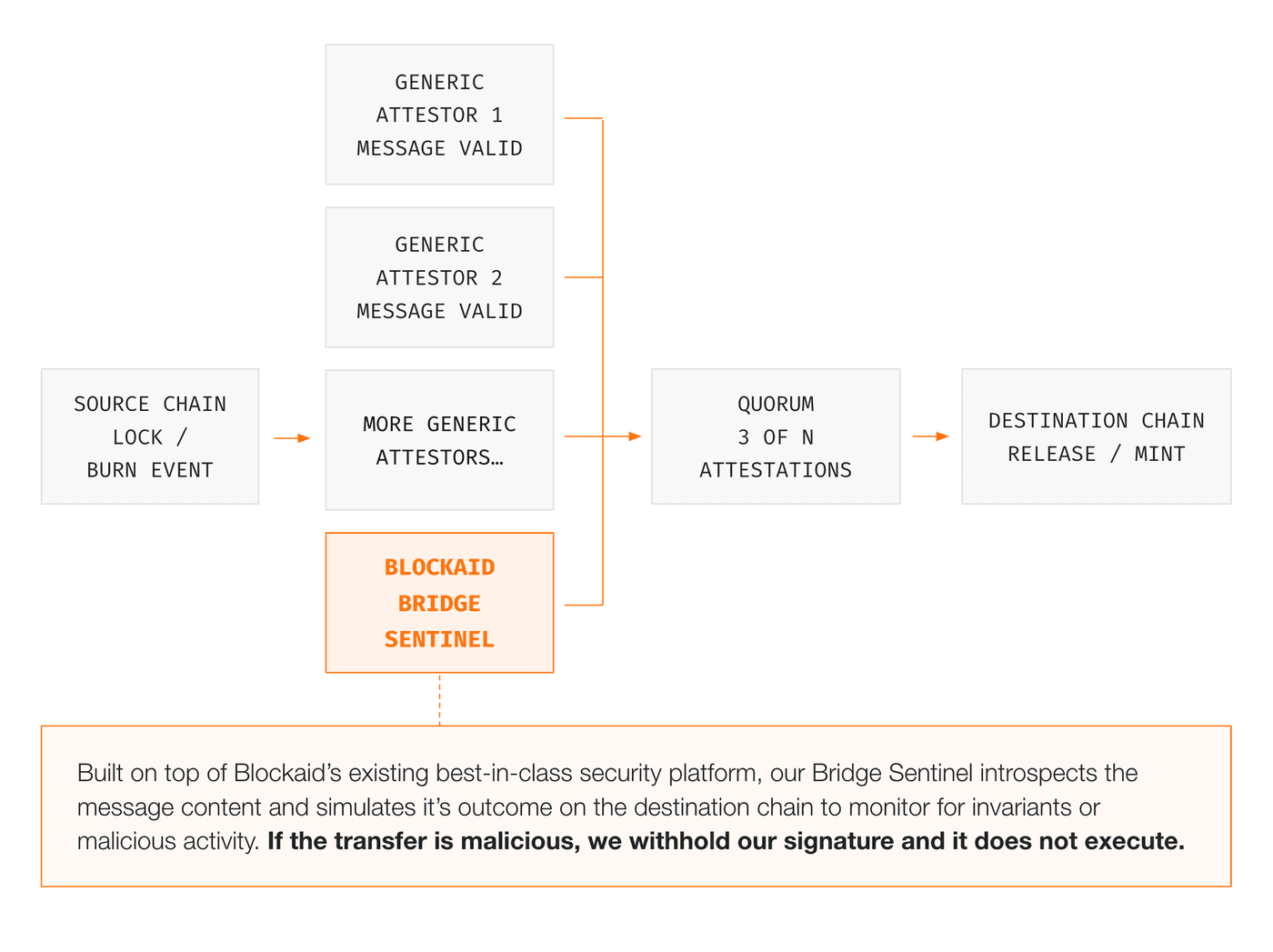
When a token moves across LayerZero, the lock or burn on the source chain produces a message, the token's configured DVNs verify it, and the destination chain releases or mints once the required attestations arrive. Each issuer decides which verifiers its token requires and how many must agree, and that configurability is what lets Blockaid bring real-time onchain security into the verification layer itself.
A conventional attestation establishes that the source event occurred, that the message matches its payload, and that quorum was reached among the configured verifiers. Nothing in that check evaluates whether the transfer should exist at all, whether the addresses behind it trace to a sanctioned party or an exploit in progress, or whether the amount it mints on the destination sits within the limits the issuer set.
Blockaid’s Bridge Sentinel occupies one of the configured verifier slots and uses it to make that second evaluation while the message is still in flight. Blockaid decodes each message's intent, screens the initiator and the recipient, enforces the issuer's value and volume limits, and checks the contract and function the message will call before deciding whether to attest. When an issuer sets Blockaid Bridge Sentinel as required, a withheld attestation means the message never completes.
Blockaid Bridge Sentinel: The Security Review Inside Every Attestation
Built on top of Blockaid’s industry leading simulation capabilities, Blockaid Bridge Sentinel runs each message through four families of checks in real-time before it signs:
- Simulate and scan every message - Blockaid Bridge Sentinel confirms that the lock or burn behind each message occurred on the source chain, and screens the originating addresses against Blockaid's threat intelligence for ties to sanctioned entities, drainer infrastructure, and active exploits. Forged source events sit behind the costliest verification failures, and this check stops one before it can become a mint.
- Apply policies on minting and burning - Before a destination chain mints, the Blockaid Bridge Sentinel does a few of verifications:
- The verifier checks the amount against a per-message cap and a rolling-window cap
- Policies can be deployed on a per route basis or globally for a specific asset.
With these checks, an oversized mint is caught while it is still a pending message, at which time the cost of refusing is zero.
- Detect anomalous configuration changes - The verifier monitors the settings that decide who can move the token, including the required verifier set and its threshold, ownership and admin roles on both chains, and the addresses holding mint, burn, pause, and rate-limit authority. If any of them change, Blockaid stops attesting, bridging on that route halts because the required threshold can no longer be met, and the issuer is notified. Compromise usually begins with a quiet settings change, and refusing to sign at that moment closes the route before a forged message can use it.
- Enforce policies on the bridged outcome - Each message is decoded down to the contract it will call and the addresses that gain value from it, and issuer-defined policies set the response, approving the message, holding it for human review, or refusing to sign. One emergency switch turns the verifier to refuse every message it handles, with no contract change or governance action required. The decision lands before execution, at the only point where a bad transfer can still be stopped outright.
The result is an attestation that carries a full security review, run by the same engine that powers the rest of Blockaid's platform.
Learn more about the Blockaid Platform →
The Stakes: Cross-Chain Verification Failures Are Accelerating
Attacks on cross-chain infrastructure are not new, but 2026 has accelerated them. Blockaid's H1 2026 Onchain Security Report found cross-chain asset bridging to be the single largest source of dollar losses in the first half of the year, across at least seven incidents, and the two months that followed added ten more, averaging a fresh failure roughly every six days.
The mechanisms varied while the root stayed constant, a destination chain trusting what a message said about the source chain without verifying it. In the costliest of these failures, a single compromised verifier held sole authority over a route, and one forged message drained funds while every contract in the path behaved exactly as designed.
Read: How Bridges Lost Another $24.6M to Cross-Chain Verification Failures →
LayerZero and Blockaid: Helping Institutions Securely Scale Cross-Chain Exchange of Value
Stablecoin issuers, payment companies, and asset managers now issue and bridge tokens as part of normal operations, and they bring the expectations of regulated markets with them, where the integrity of a settlement rail needs to be verified, not assumed. Major DeFi venues are writing that expectation into their listing rules, requiring independent security verification before an asset can be listed, and once one major venue sets that bar, others tend to follow.
For a token issuer, the moment a token gets listed and used as collateral is when its supply increases fastest, increasing the blast radius and damage of an exploit as it grows. When a fraudulent message mints tokens with nothing behind them, holders lose money and the issuer's name carries the damage, even when the failure sat in bridge infrastructure the issuer never operated. Blockaid Bridge Sentinel reviews every message inside the approval step it already has to pass, and the partnership brings that protection to the issuers building on LayerZero before their tokens reach that scale.
LayerZero and Blockaid plan to build on this partnership to deepen security for token issuers and DeFi protocols as interoperability scales across the onchain ecosystem.
Read: Blockaid's View on Security →
About LayerZero
LayerZero connects the world's most important assets to the world's most utilized blockchains. Issuers use the OFT Standard to distribute assets to 170+ chains. Chains use LayerZero Endpoints to connect to those assets and users. Wallets and exchanges use the Value Transfer API to move them. Trusted by Tether, PayPal, Paxos, Ondo Finance and Anchorage Digital, LayerZero is the standard for cross-chain interoperability.
Learn more at Layerzero.network, and Twitter.
About Blockaid
Blockaid is the onchain security platform trusted by the largest companies operating in Web3. Built by veterans of elite intelligence and cybersecurity units, Blockaid provides end-to-end protection for financial institutions, protocols, and end users, combining direct wallet and dApp integrations with real-time monitoring, detection, and response across smart contracts, infrastructure, and externally owned accounts. Since 2025, Blockaid scanned over 6.3 billion transactions and blocked 585 million attacks. Blockaid is the security infrastructure behind Coinbase, MetaMask, Uniswap, Safe, and dozens of the most widely used platforms in the industry.
Learn more at Blockaid.io, and follow us on Twitter and LinkedIn.
Blockaid is securing the biggest companies operating onchain
Get in touch to learn how Blockaid helps teams secure their infrastructure, operations, and users.
.webp&w=1920&q=75)