
Blockaid Brings Transaction Simulation and Validation to Institutional DeFi on BitGo
Executive Summary
BitGo provides the custody, wallet, staking, trading, financing, stablecoin, and settlement infrastructure institutions use to operate in digital assets, on a security model it has run since 2013 that helped pioneer institutional multi-signature wallets. The platform held more than $65 billion in assets as of June 30, 2026, and its DeFi offering gives clients access to approved protocols and applications from qualified custody and self-custody wallets.
BitGo has integrated Blockaid’s Transaction Scanning into the approval workflow behind that access. Transactions that originate outside BitGo’s platform, from the decentralized applications and protocols its clients connect to, are simulated and validated before they are signed, with the verdict surfaced inside BitGo’s own interface at the point of approval.
A transaction from an outside application can look routine and still send funds to a malicious, unintended destination. Blockaid shows what each transaction will do before anyone signs it, so BitGo’s reviewers approve with the outcome in front of them, and the institutions on its platform get a safe and secure path into DeFi.
The Partnership: Simulation and Validation Inside BitGo’s Approval Workflow
BitGo governs onchain activity through controls built for institutions. Its policy engine defines which protocols and addresses are approved, sets spending thresholds and asset restrictions, and routes each transaction through a multi-approval workflow, while a real-time audit trail records every onchain interaction with full transaction context. Those controls settle who may transact, with which assets, and within what limits, across the paths BitGo offers into DeFi.
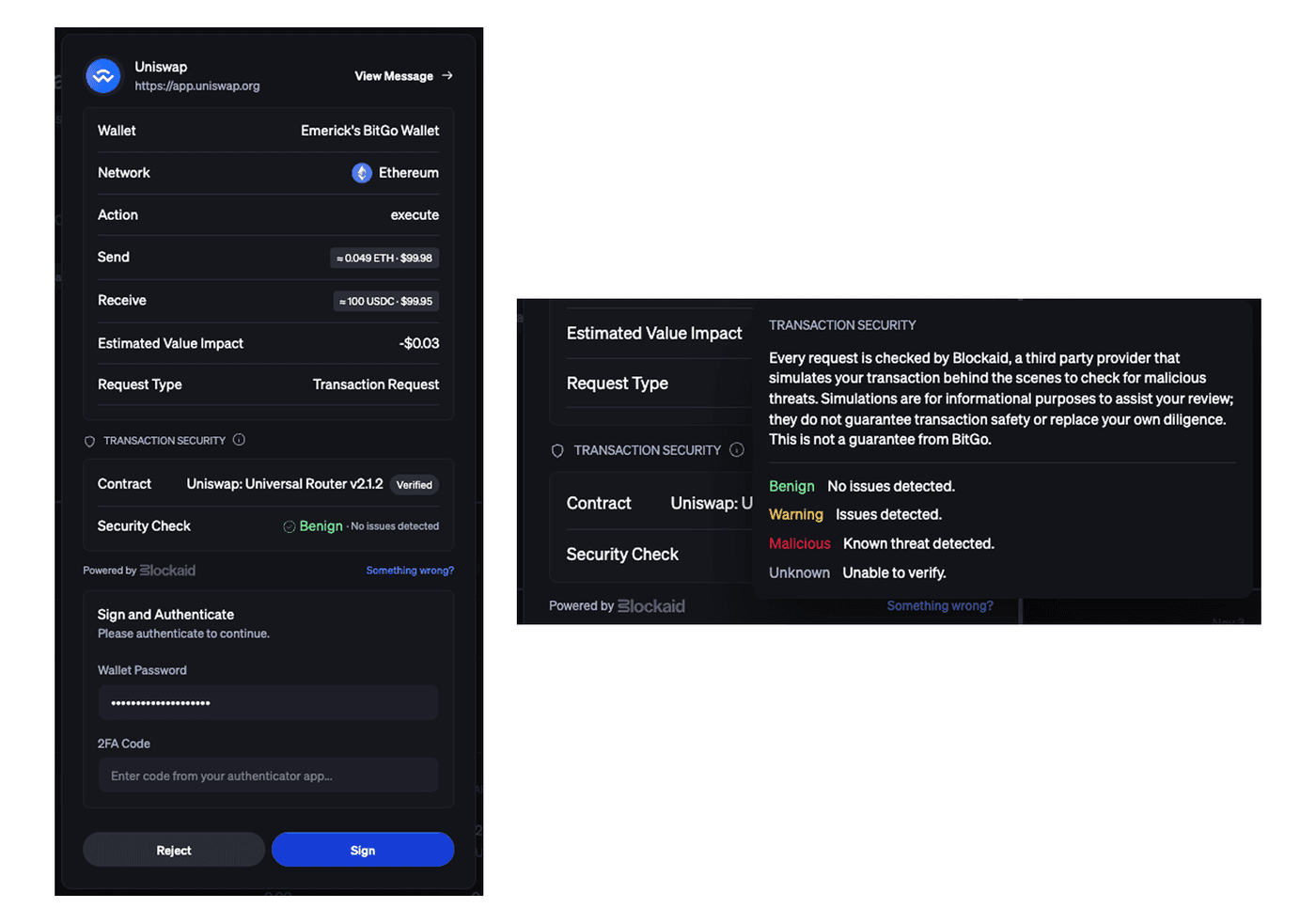
Blockaid simulates and validates each transaction before it reaches signature and returns a verdict, with a readable account of the outcome, to the step in BitGo’s workflow where the sign-off already happens. Reviewers see the assets that would move and where, the permissions that would change, and a clear risk level, on the same screen they use to approve or reject.
BitGo selected Blockaid for how that verdict is produced. Transactions are classified by what they do, so an attack that has never been seen before can still be caught, and counterparties are scored against intelligence gathered across the largest wallets, exchanges, and protocols in the industry.
Blockaid’s Transaction Scanning: Real-Time Checks Before a Signature
Blockaid’s Transaction Scanning returns a benign, warning, or malicious verdict on each transaction in real time, through connected steps that run from simulation to decision:
- Simulate the outcome - Each transaction is run against the current state of the chain before anyone signs it, recording every balance that would change, every permission that would be granted, and every contract it would call. BitGo’s reviewers see the result of a transaction before it is approved.
- Validate the behavior and the counterparties - The simulated result is scored on two axes, what the transaction does and who is on the other side of it, so an interaction is flagged whether it matches a known attack or only behaves like one. Risk is traced outward from known malicious addresses, so a wallet funded minutes ago or a fresh copy of a known drainer is caught before anyone has reported it.
- Decode the result for the approver - The verdict arrives as a plain-language summary and a risk level, which BitGo displays in the green, yellow, and red pattern it designed for its approval screens, so a reviewer who is not a smart contract engineer can act on the finding without reading calldata.
- Decide inside the flow - The scan completes within the approval step itself. A flagged transaction is held for review before any signature is released, and a clean one moves on to approval without added delay.
Learn more about Transaction Scanning →
Looking Ahead: Institutional Capital Moves Into DeFi From Custody
Institutions are arriving in DeFi through the custodians they already trust. BitGo’s clients can reach approved protocols directly from qualified custody and connect to the wider application ecosystem from self-custody wallets, and in its second-quarter results the company said it expects demand for secure, regulated infrastructure to expand as digital assets, stablecoins, and tokenized markets grow.
Each of those paths produces transactions that BitGo’s clients did not write and no policy can fully anticipate, and the value moving through them grows with adoption. Simulation and validation at the point of approval lets a custodian open that access without lowering the oversight its clients came for. Blockaid’s View on Security holds that protection has to run at the speed of the chain, inside the moments where value moves, and BitGo’s integration puts that standard inside the approval step itself as more institutional capital comes onchain.
Learn more about Blockaid’s View on Security →
About BitGo
BitGo (NYSE: BTGO) is the digital asset infrastructure company delivering custody, wallets, staking, trading, financing, stablecoins, and settlement services from regulated cold storage. Since 2013, BitGo has focused on accelerating the transition of the financial system to a digital asset economy. BitGo maintains a global presence and multiple regulated entities, including BitGo Bank & Trust, National Association, the first federally chartered digital asset trust bank owned by a publicly traded company. Today, BitGo serves thousands of institutions and millions of investors worldwide.
Learn more at bitgo.com, and follow them on Twitter and LinkedIn.
About Blockaid
Blockaid is the onchain security platform trusted by the largest companies operating in Web3. Built by veterans of elite intelligence and cybersecurity units, Blockaid provides end-to-end protection for financial institutions, protocols, and end users, combining direct wallet and dApp integrations with real-time monitoring, detection, and response across smart contracts, infrastructure, and externally owned accounts. Since 2025, Blockaid scanned over 6.3 billion transactions and blocked 585 million attacks. Blockaid is the security infrastructure behind Coinbase, MetaMask, Uniswap, Safe, and dozens of the most widely used platforms in the industry.
Learn more at Blockaid.io, and follow us on Twitter and LinkedIn.
Blockaid is securing the biggest companies operating onchain
Get in touch to learn how Blockaid helps teams secure their infrastructure, operations, and users.